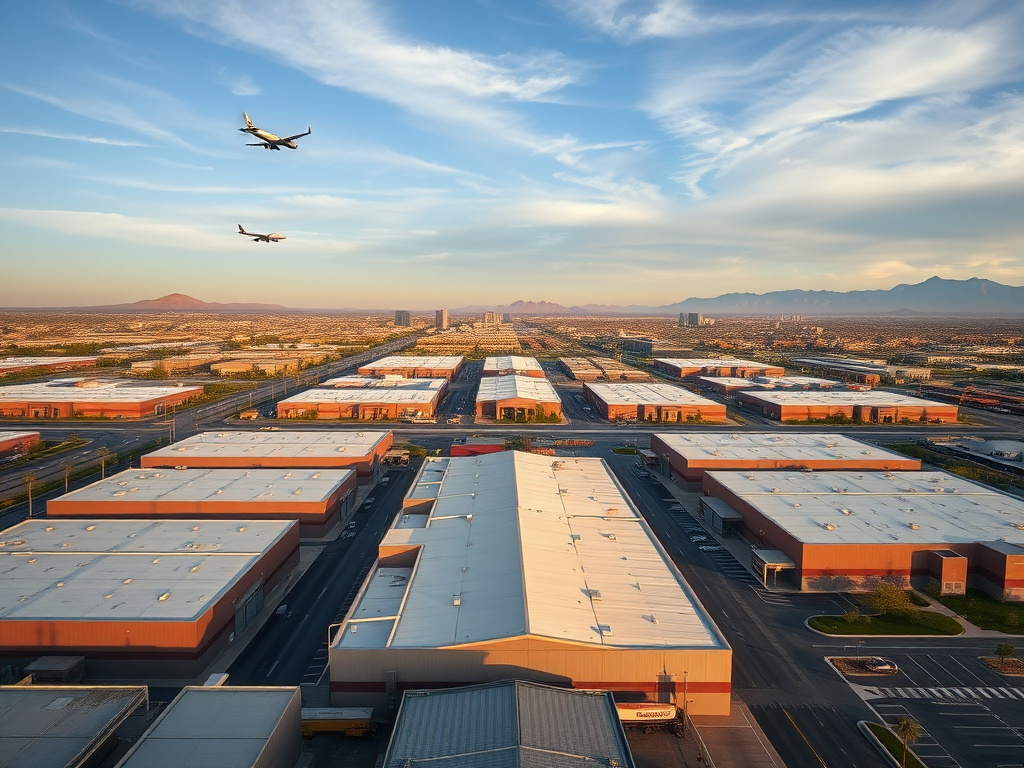
Phoenix's commercial and industrial flat-roof stock isn't evenly distributed across the Valley — it's concentrated in a handful of corridors, each shaped by a different kind of business and a different building type. A property or facility manager overseeing a building near Sky Harbor is dealing with a different roof, tenant mix, and access pattern than one overseeing a flex-industrial park near Deer Valley or an office campus in Chandler. This guide goes corridor by corridor, because the right SPF service plan — install, recoat, or an ongoing maintenance program — depends heavily on which of these areas your building sits in.
Sky Harbor-Adjacent Air-Cargo and Logistics
The blocks ringing Phoenix Sky Harbor International Airport carry a dense concentration of air-cargo, freight-forwarding, and last-mile distribution buildings. These are almost uniformly large, dead-flat roof decks running continuously across the building footprint, with rooftop HVAC units and dock-level equipment penetrations that need careful flashing and foam detailing to hold up under constant loading and unloading activity below. Because these facilities frequently run near-continuous operating hours tied to flight and freight schedules, install and recoat work in this corridor is typically staged in sections timed around the building's own cargo flow rather than a fixed daytime-only window.
The I-10/I-17 Industrial Belt
The industrial corridor strung along I-10 and I-17 through west and south Phoenix is warehouse and light-manufacturing territory — big-box distribution centers and manufacturing buildings with acres of low-slope roof per site. A single building in this corridor can represent more total roof area than several smaller commercial properties combined, which makes minimal-downtime scheduling and tapered foam application for drainage correction especially valuable: a large, mostly featureless deck is exactly the kind of surface where a seamless SPF system's speed of application and slope-building flexibility pays off most.
Deer Valley and North Phoenix Flex-Industrial Parks
North Phoenix's flex-industrial parks near Deer Valley Airport mix small-bay warehouse, showroom, and light-assembly space under shared rooflines — often with several separate tenants operating under one continuous roof deck. That multi-tenant reality changes the planning conversation: a recoat or repair project in this corridor usually has to be scheduled around several businesses' operating hours at once, with access coordinated tenant by tenant rather than through a single building manager.
Tempe's ASU-Adjacent Office and Multifamily Stock
The office and multifamily buildings clustered around Tempe and ASU carry a different profile again — flat roofs over buildings that are occupied around the clock by residents or on-site staff, not just during business hours. Noise windows, resident notification, and tight access coordination matter as much in this corridor as the actual foam specification does, since a multifamily roof project happens directly above people's homes rather than an empty warehouse floor.
Chandler's Tech and Semiconductor Corridor
Chandler's tech and semiconductor employers sit on large, newer office and light-industrial campuses, often with sensitive rooftop mechanical and electrical equipment supporting cleanroom or data-sensitive operations below. Roofs in this corridor tend to be newer and better-detailed to start with, which shifts the service conversation toward scheduled recoat cycles and clean, precise penetration detailing around equipment — protecting a substantial mechanical investment rather than correcting decades of deferred maintenance.
Why Large Flat Decks Favor a Seamless, Tapered System
Nearly every building type across these five corridors shares one structural trait: large, dead-flat or barely-sloped roof decks that were never built with much natural drainage. That's true of a Sky Harbor air-cargo hangar, an I-10/I-17 distribution warehouse, and a Deer Valley flex-industrial building alike. Because spray polyurethane foam is applied as a liquid rather than laid in fixed sheets, a crew can vary foam depth across the same roof to build in real slope-to-drain — correcting decades of standing water risk in the same pass as the install or recoat, instead of requiring a separate tear-off and re-deck. On a roof measured in tens of thousands of square feet, that tapering capability is often what makes foam the more practical system compared with a fixed-sheet membrane in the first place.
The same seamless quality also matters for Phoenix's climate specifically. A commercial roof deck in any of these corridors can swing 40-60°F or more between a summer afternoon peak and the pre-dawn low, and that daily cycle is exactly what works seams, laps, and fasteners loose on a jointed system over enough years. A fully adhered, seamless foam membrane gives that heat cycle nothing to find a gap in — which is one reason facility managers across these corridors increasingly treat foam recoat cycles as a planned budget line rather than a reactive leak-call expense.
Matching the Corridor to the Right Service Line
Across all five corridors, the underlying service lines are the same — new commercial flat-roof foam installation, recoating an aging system, and repair — but which one applies, and how it's scheduled, depends on the building. A Sky Harbor logistics facility or an I-10/I-17 distribution warehouse is usually thinking about a large-scale install or recoat scheduled around continuous operations. A Deer Valley flex-industrial park is usually managing several tenants' access needs on one shared roof. A Chandler tech campus is usually protecting newer equipment with a tighter recoat cycle. Property managers overseeing buildings across more than one of these corridors are typically best served by a standing roof maintenance and inspection program that coordinates scheduled checks and recoat planning across a whole portfolio, rather than treating each building's roof as a separate, reactive decision.
Wherever your building sits — Sky Harbor, the I-10/I-17 belt, Deer Valley, Tempe, or Chandler — the same seamless SPF system and the same crew handle the work, scoped to how that specific corridor actually operates.
Frequently asked questions
Which Phoenix commercial areas have the most flat-roof stock that fits SPF systems?
+
The Sky Harbor-adjacent air-cargo and logistics belt, the I-10/I-17 industrial corridor through west and south Phoenix, Deer Valley's flex-industrial parks, Tempe's ASU-adjacent office and multifamily stock, and Chandler's tech and semiconductor corridor all carry large concentrations of dead-flat or low-slope commercial roofs that are a direct fit for a seamless foam system.
Can a foam roof be installed or recoated without shutting down an operating facility?
+
Yes — commercial SPF work is typically staged section by section and scheduled around a building's actual operating hours, loading dock activity, and tenant access needs, rather than requiring the facility to close. The specific staging plan depends on the building type and how it's used day to day.
Do multi-tenant flex-industrial buildings need a different approach than a single-tenant warehouse?
+
Often, yes. A multi-tenant flex-industrial building near Deer Valley may need work scheduled around several businesses' hours under one shared roofline, while a single-tenant distribution warehouse along the I-10/I-17 belt usually allows for a more continuous install schedule across one large, uninterrupted roof deck.
What roofing service makes sense for a property manager overseeing multiple commercial buildings across different corridors?
+
A standing maintenance and inspection program is generally a better fit than one-off leak calls for a multi-property portfolio, since it lets a facility team plan recoat cycles and catch storm or UV damage across several buildings on one coordinated schedule instead of reacting building by building.