Commercial SPF roofing
Commercial Flat Roof Foam Systems for Phoenix Businesses
A seamless spray polyurethane foam system for warehouses, strip retail, office parks and industrial buildings across the Valley — installed over an occupied property with a schedule built around your operating hours, not ours.
Built for the way Phoenix does business
A B2B roofing conversation, not a homeowner sales pitch
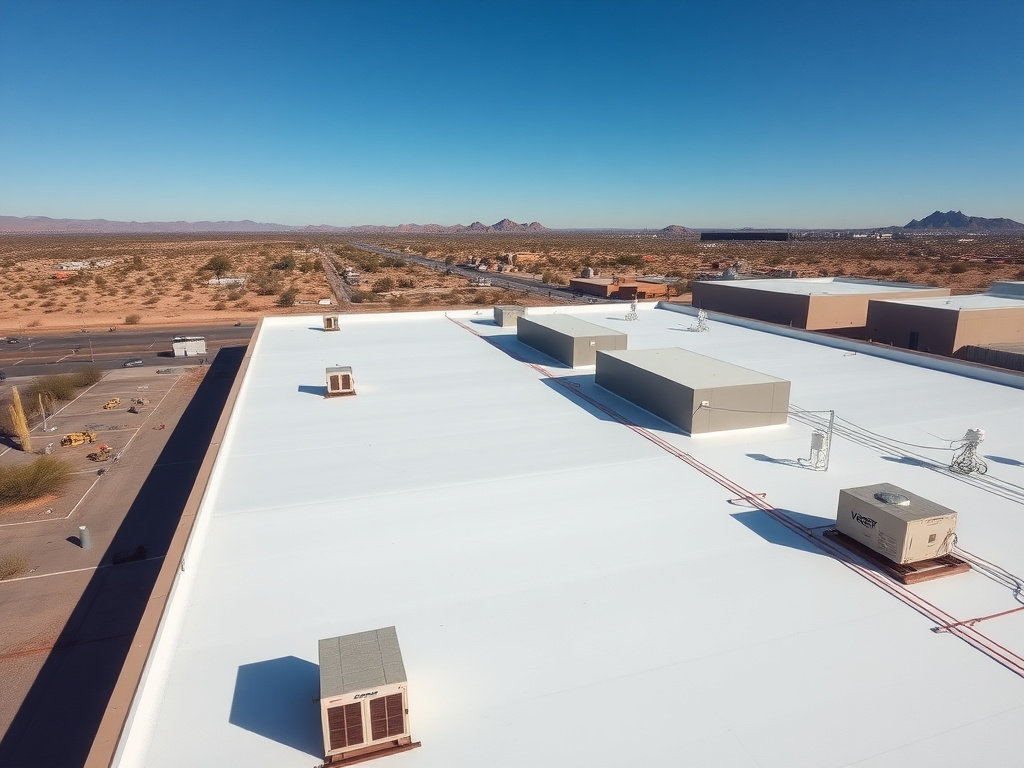
This page is for the people who actually manage a Phoenix commercial roof — facility managers, property management firms, general contractors on a tenant improvement job, and business owners who own their building outright. The building types we work on most are dead-flat or low-slope: distribution warehouses, strip retail centers, single-story office parks, flex-industrial buildings, and light manufacturing space. Almost none of that stock was built with a pitched roof, and almost all of it is aging out of whatever built-up or single-ply system it shipped with.
Spray polyurethane foam is a fully adhered, seamless membrane sprayed directly onto the existing deck or a prepared substrate. There's no seam pattern for wind to find and no fastener pattern for a re-roof crew to chase down one at a time. For a large commercial roof — and Phoenix has an enormous amount of large flat commercial roof — that seamless, monolithic quality is the entire value proposition: fewer future leak points per square foot than any seamed alternative, and a foam depth that can be varied across the same roof to correct drainage in the same pass as the install.
The commercial buying decision usually comes down to three things a property owner or facility manager can actually measure: how much roof downtime the project requires, how the system performs on a deck that was never built to drain correctly, and what it costs to maintain over a 10, 20, or 40-year hold period. This page walks through all three specifically for the building types and corridors that make up most of Phoenix's commercial flat-roof stock, rather than treating a 200,000-square-foot distribution center the same way a residential roofing crew would treat a house.
Why seams are the first thing to fail here
What Phoenix's heat cycling does to a seamed commercial roof
A single-ply or built-up commercial roof relies on seams, fasteners, and adhered laps to stay watertight, and every one of those joints is a point where the material can move. Phoenix roof surfaces routinely swing from a pre-dawn low into a peak summer-afternoon high separated by 40 to 60 degrees or more on the same deck, day after day for months. That expansion-and-contraction cycle works at every seam and fastener line on a traditional commercial roof, and over enough summers it's the single biggest driver of the leak calls we get on older TPO, EPDM, and built-up tar-and-gravel commercial roofs across the Valley.
A fully adhered, monolithic SPF membrane doesn't have that failure mode. There is no seam for the daily heat cycle to work loose and no fastener line for wind uplift to find during a monsoon downburst. For a facility manager comparing a foam re-roof quote against a like-for-like replacement of the existing seamed system, that structural difference — not just the reflective topcoat — is usually the strongest argument for foam on a large commercial deck.
Where the Valley's commercial roof stock actually sits
Phoenix's commercial geography, corridor by corridor
Phoenix's commercial flat-roof inventory isn't clustered in one part of town — it's spread across a handful of corridors that each have their own building type, and each corridor shows up in our schedule differently. Knowing which corridor a property sits in tells us most of what we need before we even see the roof: expected deck size, typical rooftop equipment load, and how tightly the schedule has to work around the tenants underneath.
Sky Harbor-adjacent logistics & air-cargo
The blocks ringing Phoenix Sky Harbor International Airport carry a dense concentration of air-cargo, freight-forwarding, and last-mile distribution buildings — almost all large, dead-flat roof decks running continuously with rooftop HVAC and dock-level equipment penetrations that need to be foamed and flashed correctly the first time.
The I-10 / I-17 industrial corridor
The industrial belt strung along I-10 and I-17 through west and south Phoenix is warehouse and light-manufacturing territory — big-box distribution centers with acres of low-slope roof per building, where a minimal-downtime install schedule matters more than almost anywhere else on this list.
Deer Valley & north Phoenix flex-industrial
North Phoenix's flex-industrial parks near Deer Valley mix small-bay warehouse, showroom, and light-assembly space under one roofline — often multiple tenants sharing a single roof, which means recoat and repair work has to be scheduled around several businesses' hours at once, not just one.
Tempe & ASU-adjacent office/multifamily
The office and multifamily stock around Tempe and ASU carries a different profile — flat roofs over occupied buildings with residents or staff on-site around the clock, where noise windows and access coordination are as much a part of the job as the foam spec.
Chandler's tech & semiconductor corridor
Chandler's tech and semiconductor employers sit on large, newer office and light-industrial campuses — roofs that carry sensitive rooftop mechanical and electrical equipment, where drainage correction and clean penetration detailing are non-negotiable.
Strip retail & office parks, Valley-wide
Outside the named corridors, the Valley's ordinary strip retail centers and single-story office parks make up the largest share of our commercial workload by volume — smaller roofs, but the same seamless-membrane and drainage logic applies.
Whichever corridor a building sits in, the underlying deck problem is usually the same: a low-slope or dead-flat roof that was designed for a lower-cost seamed system decades ago, carrying more rooftop mechanical load today than it was ever specified for, and due for a re-roof decision that will set the building's roof performance for the next several decades.
Minimal downtime, correct drainage
Installing over an occupied building, and fixing dead-flat drainage in the same pass
Almost every commercial job on this page happens on a building that's still operating — tenants receiving freight, staff working under the roof, retail doors open to customers. That changes how the job is planned. Spray application happens in sections, staged so mechanical equipment, loading docks, and entrances stay usable through the work, and application windows are set around the building's own operating hours rather than a generic 7-to-3 schedule.
Most Phoenix commercial decks were built dead-flat or close to it, with little or no built-in slope to a drain. That's a design problem foam is uniquely suited to solve: because it's spray-applied rather than laid in a fixed sheet, the crew can vary foam depth across the same roof to build in a tapered, slope-to-drain profile — correcting decades of standing-water exposure in the same install instead of requiring a separate tear-off and re-deck.
Roof + operations assessment
Deck condition, existing membrane, rooftop equipment layout, and the building's operating schedule get mapped together before a plan is written.
Downtime-minimized scheduling
Work is staged section by section around loading docks, tenant hours, and HVAC access so the building keeps running.
Substrate prep
Existing surface is cleaned, repaired, and primed so the foam bonds fully across the deck.
Tapered foam application
Foam depth is varied across the roof to build positive slope to drains, correcting ponding that a fixed-sheet system couldn't fix without tear-off.
Topcoat + walk-through
A protective silicone or acrylic topcoat is applied, drains and penetrations are inspected, and the building is handed back with a punch-list walk-through.
For the facility manager watching utility spend
A roof decision that shows up on the utility bill
On a large commercial roof, the difference between a dark, aged membrane and a reflective SPF-and-topcoat system isn't cosmetic — it's a measurable reduction in how much heat gets transferred into the building through the roof deck, which directly affects HVAC run time and the cooling line on a Phoenix utility bill. For a facility manager evaluating a re-roof against a full budget cycle, that operating-cost angle is usually as relevant as the install quote itself.
Depending on the building type and product spec, a commercial re-roof in the Phoenix service territory can also qualify for a utility-run cool-roof rebate. SRP and APS — the two utilities serving most of the Valley's commercial footprint — each run a named cool-roof rebate program tied to the roof coating carrying a current Cool Roof Rating Council product rating and, in most cases, a minimum warranty term. On top of the utility rebate, the City of Phoenix also sets a minimum solar reflectance and thermal emittance requirement for low-slope commercial and multifamily re-roofs affecting more than half the roof area, with a handful of standard exemptions.
We treat all of that as a paperwork-support conversation, not a guarantee — rebate dollar amounts, program caps, and code thresholds are set by the utility and the city, not by us, and they do change between program cycles. Our Cool Roof & Energy Rebates page walks through current SRP and APS program specifics in more detail, and we confirm the live figures with the utility or the city before any number goes into a commercial proposal.

Beyond the install
A standing relationship, not a one-time invoice
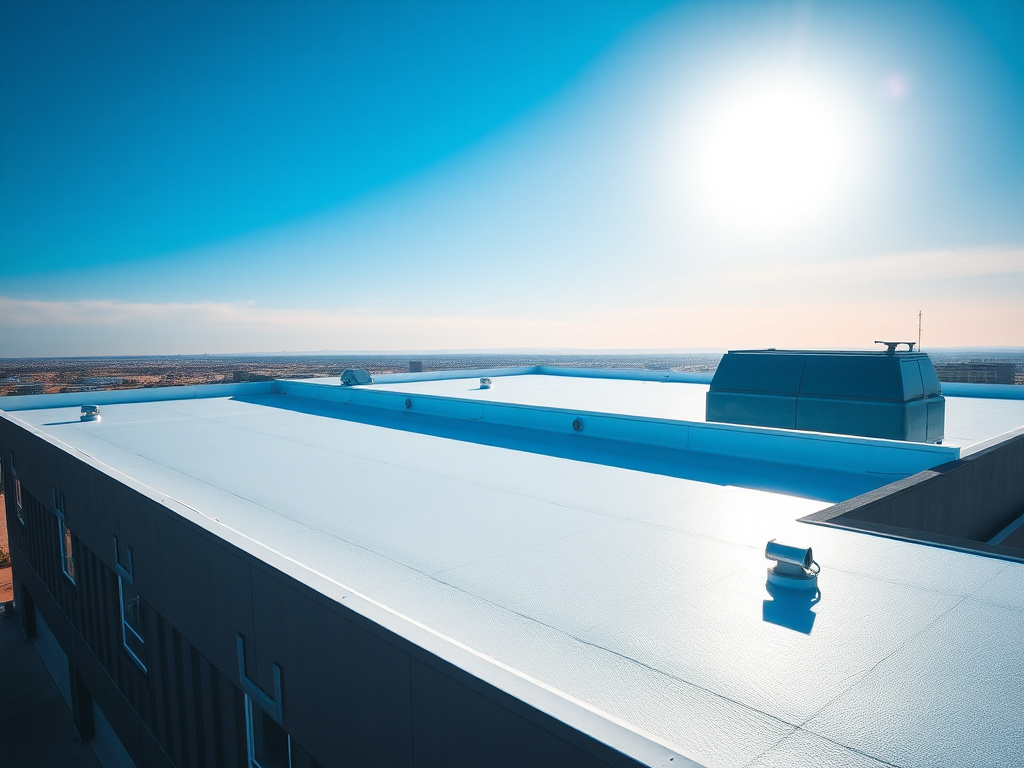
A commercial roof doesn't stop needing attention the day the crew leaves. Property managers and multi-site facility teams are usually better served by a standing inspection and recoat-planning relationship than by waiting for the next leak call — bi-annual inspections timed around monsoon season catch UV and storm damage while it's still a patch job instead of a re-roof.
That matters more for a commercial building than a house, because the cost of being wrong is bigger: a leak over a warehouse floor full of inventory, a data closet, or a retail sales floor is a different kind of problem than a leak over a spare bedroom. A standing inspection relationship also gives a property manager something to hand a roofing budget line to at renewal time — a documented recoat schedule instead of an unplanned emergency repair invoice.
- ✓Scheduled pre- and post-monsoon roof inspections
- ✓Recoat-cycle planning tied to warranty terms
- ✓Priority response for active leaks on managed properties
- ✓Multi-property reporting for portfolio-level roof budgeting
Read more on our Roof Maintenance Programs page for how a retainer arrangement works for a single building or a portfolio.
Whichever corridor your building sits in — Sky Harbor, the I-10/I-17 belt, Deer Valley, Tempe, or Chandler — the same crew and the same seamless SPF system apply. See the full list of communities we cover on our Service Areas page.
Request a commercial roof site visit
Send us the building's size, roof type, and any known drainage or leak issues. We'll schedule a site visit and come back with a scoped commercial proposal — no downtime guesswork, no obligation.