A decision-stage guide, not a sales pitch
Spray Foam Roofing vs. Traditional Roofing: What Actually Performs Best in Phoenix
Shingle, TPO, EPDM, and built-up tar-and-gravel all still have a place on Phoenix roofs. This page compares each of them to spray polyurethane foam on the categories that actually decide how a roof performs here — heat, monsoon exposure, repair cost, and HOA color rules — so you can make the call with real information instead of a sales script.
Why this comparison matters here
The right roofing system depends on the roof, not a brand preference
Most roofing comparisons online are written for a generic climate. Phoenix isn't generic. Roof surfaces here regularly run well above 150°F in peak summer, the monsoon window brings wind-driven rain and occasional hail across a fixed June 15–September 30 stretch, and a large share of the Valley's housing stock sits inside HOA-governed communities where a roof's color is part of the decision, not an afterthought. Those conditions change how each system actually performs, not just how it's marketed.
This page isn't trying to talk you out of a shingle roof or a built-up system where either is the right call. It's a side-by-side look at how spray polyurethane foam (SPF) stacks up against the three traditional systems most common here — asphalt shingle on pitched sections, TPO/EPDM membrane on flat commercial roofs, and older built-up tar-and-gravel roofing on aging Phoenix commercial stock.
Shingle comparison
SPF vs. asphalt shingle (pitched roof sections)
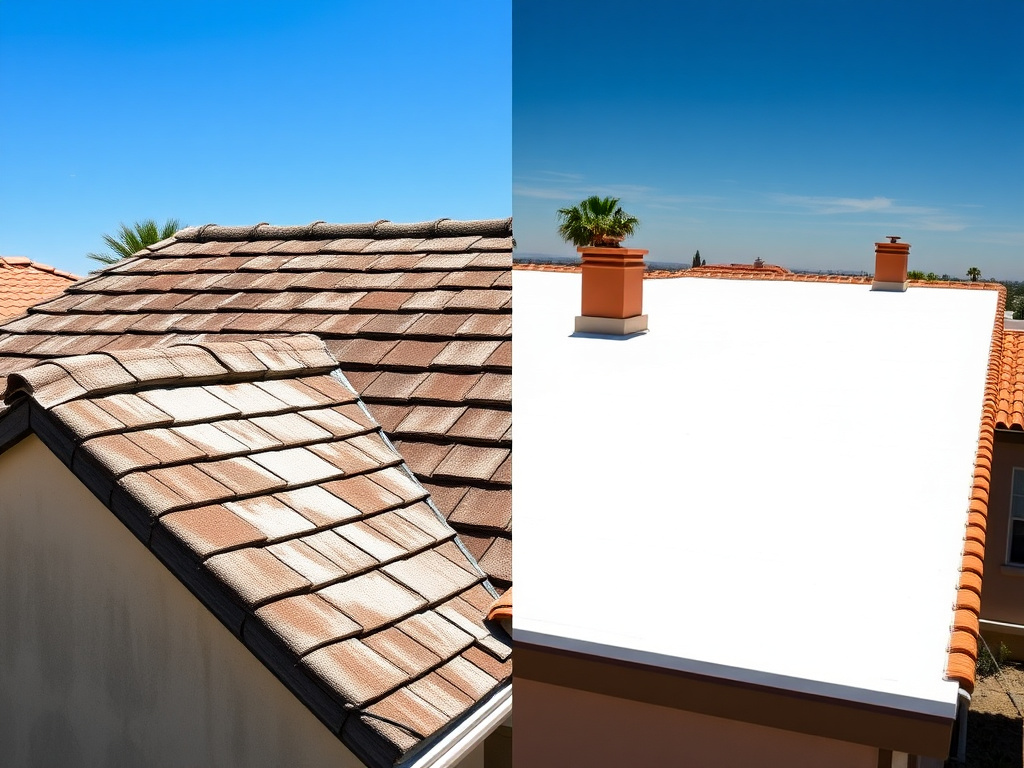
Shingle and SPF aren't installed on the same roof plane in most cases — shingle is a pitched-roof product, SPF is applied to flat and low-slope sections. Plenty of Phoenix properties have both: a shingled main roof with a flat addition, casita, or patio cover. Here's how the two compare where they do overlap in scope.
| Upfront cost | Asphalt shingle is generally the least expensive material per square foot; SPF costs more up front but applies only to flat/low-slope areas shingle can't cover anyway. |
|---|---|
| Typical lifespan | Standard 3-tab or architectural shingle typically runs 15-25 years in Phoenix's UV load; a properly maintained SPF system with recoat cycles can reach 40-50+ years, per longstanding SPFA industry data. |
| Reflectivity & cooling performance | Dark shingle absorbs and holds heat, adding to attic temperature; a reflective SPF topcoat runs meaningfully cooler on the surface and can ease cooling load on the space below. |
| Repairability | A damaged shingle section is usually patched by replacing individual shingles; SPF's seamless membrane allows spot repair of a leak or penetration without disturbing the surrounding field. |
| Monsoon & wind performance | Shingle can lift or tear in high monsoon wind gusts if fasteners or seals are compromised; seamless foam has no shingle tabs to lift, though flashing and edge detailing still matter on both. |
| HOA color-compliance flexibility | Shingle color options are set by the manufacturer's product line; SPF topcoats can be tinted to a wider custom range, which helps match a specific community's approved palette. |
Shingle remains sound and cost-effective on steep-pitch sections.
Flat commercial comparison
SPF vs. TPO/EPDM (flat commercial membrane roofing)
TPO and EPDM are the two membrane systems we run into most often on Phoenix strip malls, warehouses, and office parks. Both are legitimate flat-roof products — the comparison below is about where each one holds up under this specific heat and monsoon load.
| Upfront cost | TPO and EPDM membrane installs typically run below SPF per square foot on a straightforward, low-penetration roof; the cost gap narrows on roofs with heavy equipment penetrations or ponding to correct. |
|---|---|
| Typical lifespan | TPO/EPDM manufacturer warranties commonly run 15-30 years depending on membrane thickness; SPF's recoat-to-extend model can push service life well past that when the topcoat is maintained on a 10-20 year cycle. |
| Reflectivity & cooling performance | White TPO is highly reflective out of the box; EPDM is typically black and absorbs heat unless coated. A reflective SPF topcoat performs comparably to white TPO and can be renewed at recoat rather than replaced. |
| Repairability | Membrane seams are the most common failure point on TPO/EPDM and often require a trained technician to re-weld or patch; SPF's monolithic surface has no seams to fail in the first place. |
| Monsoon & wind performance | Membrane systems rely on mechanical fastening or adhesive at the perimeter and seams, which is where wind uplift failures concentrate; foam's fully adhered, seamless application removes that specific failure mode. |
| HOA color-compliance flexibility | Membrane color is limited to what the manufacturer offers (white, gray, tan on some lines); SPF topcoats can be custom-tinted, which matters more for HOA-adjacent commercial parcels than for most standalone commercial sites. |
TPO/EPDM is a proven system — this compares where foam's seamless application changes the failure modes.
Older commercial stock
SPF vs. built-up tar-and-gravel roofing
Built-up roofing (BUR) — alternating layers of asphalt and felt, finished with a gravel ballast — is still common on older Phoenix commercial buildings. It's a durable system in its own right, but decades of Phoenix sun and repeated monsoon seasons take a specific toll on it.
| Upfront cost | A full BUR tear-off and replacement is typically one of the more expensive traditional options; an SPF recover installed over sound existing BUR substrate can come in below a full tear-off. |
|---|---|
| Typical lifespan | Built-up roofs commonly run 20-30 years before requiring major work; SPF systems recoated on schedule are commonly rated 40-50+ years by industry data, extending well beyond a typical BUR service life. |
| Reflectivity & cooling performance | Gravel-ballast BUR surfaces are dark and heat-absorbing by default; a reflective SPF topcoat run over BUR meaningfully lowers surface temperature and can help with cooling load and code-driven reflectance requirements. |
| Repairability | A BUR leak often requires locating the source under multiple layers and gravel ballast, which can mean disturbing a wide area; SPF's seamless surface makes locating and spot-sealing a leak considerably faster. |
| Monsoon & wind performance | Aging BUR seams and flashings are common monsoon failure points, and gravel ballast can shift or scour in high wind; foam's fully adhered membrane removes the loose-ballast wind risk entirely. |
| HOA color-compliance flexibility | BUR's gravel-cap finish isn't really a color-compliance product at all; an SPF recoat over sound BUR gives a commercial or mixed-use property real color options where an HOA or design review applies. |
Many aging BUR roofs are strong recover candidates for foam instead of a full tear-off.
Where traditional materials still win
Foam isn't the right answer everywhere, and we'll say so
Spray foam is a flat and low-slope roofing product. It isn't applied to steep-pitch roof sections, and we don't try to make it one. On a traditional pitched Phoenix home, architectural or tile shingle remains the right call — a mature, well-understood product with a strong track record on pitch. Switching a pitched section to another system isn't a like-for-like upgrade so much as a different set of tradeoffs.
A few other situations favor a traditional material: a roof nearing the end of its life on a property being sold or redeveloped soon, where a lower-cost like-for-like replacement makes more sense than a longer-life investment; or a small, simple pitched section where a foam crew's mobilization minimums don't pencil out against a straightforward shingle patch. An honest quote accounts for these cases instead of steering every roof toward the same recommendation.
- ✓Steep-pitch sections — foam isn't applied to pitched roofs; shingle or tile remains the standard product there.
- ✓Near-term property sale or redevelopment — a lower-cost like-for-like repair can outperform a longer-life investment on a short ownership horizon.
- ✓Very small, simple pitched patches — a traditional repair can be the more practical fix for a minor, isolated issue.
- ✓Budget-constrained short-term fixes — a traditional patch can buy time before a fuller re-roof decision, scoped honestly as a short-term fix.
Decision framework
Which system is right for your Phoenix property
Flat commercial building
Strip malls, warehouses, and office parks with existing TPO, EPDM, or built-up roofing are often strong recover candidates for SPF, sometimes at a lower cost than a full tear-off, with reflectance that can help meet City of Phoenix cool-roof code.
HOA-governed residential property
A flat addition, casita, or low-slope section inside a master-planned community benefits from SPF's tintable topcoat, which offers more color options than a fixed membrane line. See our HOA-Compliant Roofing page for how that process works.
Older Phoenix ranch home
Many 1960s-80s Valley ranch homes have dead-flat original roofing prone to ponding. SPF's tapered application corrects slope-to-drain issues during install — something a like-for-like replacement generally can't do on its own.
New construction
New builds with flat or low-slope sections are the cleanest case for SPF — slope-to-drain, foam depth, and topcoat reflectance can all be specified from day one instead of retrofitted onto an existing structure later.
Common questions
Questions we hear when comparing roofing systems
Is spray foam roofing actually better than shingle roofing in Phoenix?
+
For flat and low-slope sections, yes, on the categories that matter most here — reflectivity, seamless waterproofing, and spot-repairability. Shingle isn't a like-for-like competitor there since it's a pitched-roof product. On steep-pitch sections, shingle remains a sound, cost-effective choice, and we'll say so.
Does spray foam roofing cost more than TPO or built-up roofing upfront?
+
Per square foot, SPF generally sits above TPO/EPDM and roughly in line with multi-ply built-up roofing on initial install, depending on foam depth and topcoat spec. The gap narrows over the roof's life since foam is recoated rather than replaced — get a same-scope quote on both to compare your project.
Can spray foam be applied over an existing TPO, EPDM, or built-up roof?
+
Often, yes, if the existing substrate is dry, structurally sound, and free of trapped moisture — a foam recover avoids a full tear-off in many cases. Every roof still needs an on-site inspection first, since hidden moisture or delamination rules out a recover regardless of topcoat.
Which roofing system holds up best in an Arizona monsoon?
+
Seamless SPF has no laps or seams for wind-driven rain to find, a real advantage during the June 15-September 30 monsoon window. Properly installed TPO, EPDM, and built-up systems can also perform well when seams and flashing are sound — monsoon performance comes down heavily to installation quality and maintenance, not material alone.
Get a free side-by-side comparison estimate
Tell us about your roof and we'll quote both a foam system and the traditional alternative where it's a realistic option, so you can compare real numbers instead of general ranges.