
New Install & Full Reroof
Spray Foam Roof Installation for Phoenix New Construction and Reroofs
A new SPF roof goes down as a single seamless membrane, sloped to drain from day one and finished with a protective topcoat — built for a roof surface that runs 150-170°F+ through a Phoenix summer.
Where a new roof starts
The conversion page for new-build and full-replacement roofs
This is the service for a roof that's starting over — new construction with no roofing system in place yet, or an existing roof at the end of its life where a recoat is no longer the right call. Spray polyurethane foam (SPF) is applied on-site as a liquid that expands and cures into a rigid, fully adhered membrane, then sealed under an elastomeric topcoat. There's no seamed sheet goods, no mechanical fasteners working loose, and no field joints for Phoenix's heat and monsoon cycle to find and open over time.
If your existing roof is an aging SPF system that just needs its topcoat renewed rather than a full tear-off, see foam roof recoating instead — this page is specifically for roofs going in new or coming off entirely. We install across the Valley; check our service areas for the cities we cover.
New construction and full replacement are two different conversations that land on this same page. A new build has a bare deck and no drainage history to work from, so the crew is specifying slope and foam depth from a blank slate. A full replacement usually means an older built-up, modified bitumen, or shingle system that's failed in enough places that patching or recoating it further doesn't make sense — the existing roofing comes off (or is recovered over, where the deck allows it) and a new SPF system goes down in its place. Either way, commercial and residential jobs run the same core process; what changes is scale, access, and how much scheduling has to work around an occupied building.
What's involved
Substrate prep, tapered foam depth, and a protective topcoat
A new install starts with the substrate, not the spray gun. The deck gets cleaned, dried, and checked for damaged decking or delamination that needs to be addressed before anything gets sprayed — foam applied over a compromised substrate just locks the problem in underneath a new membrane.
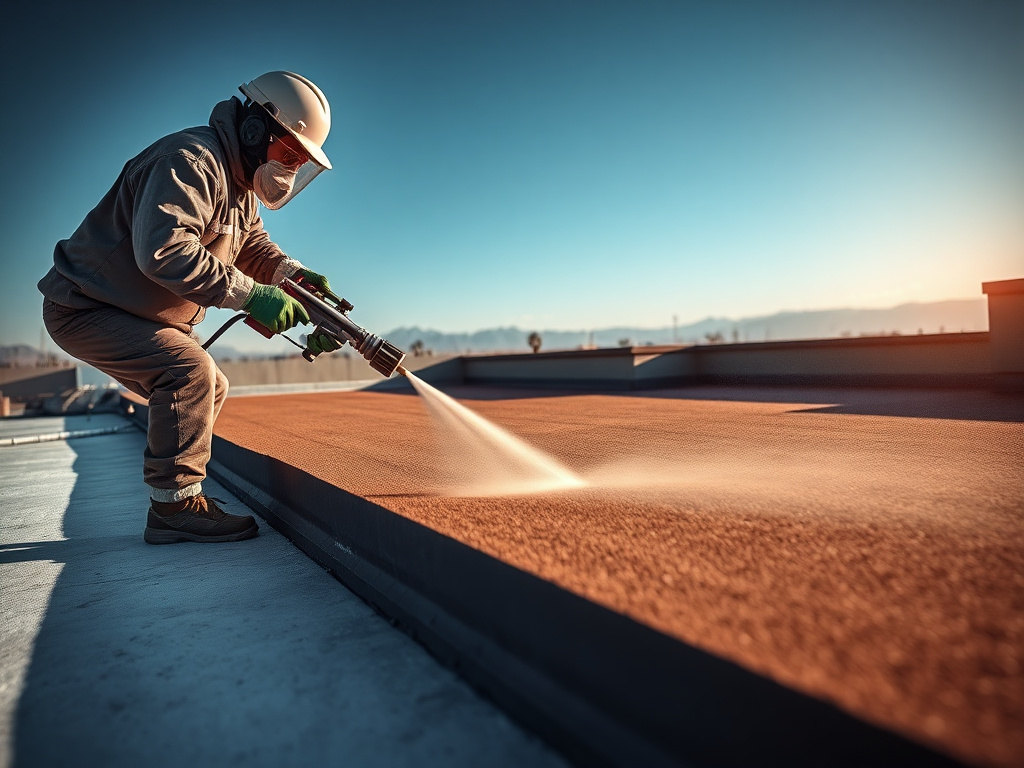
From there, foam depth is varied across the roof on purpose. Rather than spraying a flat, uniform layer over a deck that has no real pitch, the crew builds slope-to-drain tapering directly into the foam — thicker in the field, thinner approaching drains and scuppers — so the roof actually sheds water instead of holding it. That tapering is decided and built during installation, not bolted on afterward.
Once the foam cures, it's sealed under a reflective elastomeric topcoat (silicone or acrylic) that protects the foam from UV exposure and gives the finished roof its walkable, weather-facing surface.
Application runs through heated plural-component spray rigs that mix the foam components at the nozzle and lay it down in a continuous pass, and the crew is checking foam thickness and adhesion as they go rather than only at the end of the job. That in-process monitoring is what lets the tapering come out even and the finished depth match spec across the whole roof, not just at a few sample points.
Why seams are the weak point
A seamless membrane matters more in Phoenix than almost anywhere else
A Phoenix roof surface doesn't just get hot — it swings. Peak summer surface temperatures regularly climb past 150-170°F in direct sun, then fall to a pre-dawn low as the desert air radiates heat back out overnight. That daily gap between the afternoon peak and the early-morning low can run 40-60°F or more, every single day, for months.
Seamed roofing systems — built-up tar-and-gravel, modified bitumen, mechanically fastened membrane sheets — expand and contract with that swing, and every seam, lap, and fastener penetration is a place for that movement to eventually work something loose. SPF doesn't have that failure point. It's sprayed as a continuous, fully adhered membrane with no seams to open, so the daily heat cycle that stresses jointed materials has nothing to find a gap in.
It matters just as much once monsoon season starts. Wind-driven rain and dust look for exactly the entry points a seamed system offers — a lifted lap, a loose fastener, a seam that's already opened a hair from a thousand heat cycles — and push moisture and debris in behind them. A membrane with no seams to begin with gives that wind-driven water and dust nowhere to get behind, which is a big part of why SPF roofs generally hold up better through repeated monsoon storms than the seamed alternatives.
150-170°F+
Peak roof surface temp
40-60°F+
Daily surface swing
0
Seams in the membrane
108 Days
Monsoon season window
Who this is for
Built for the Valley's flat and low-slope roof stock
New SPF installation isn't a fit for every roof — it's specifically suited to flat and low-slope decks, which describes a large share of the Phoenix metro's building stock, both commercial and residential.
Commercial flat & low-slope roofs
Strip retail, warehouses, and office buildings across the Valley with dead-flat or low-slope decks that need a new roofing system installed with minimal disruption to an occupied building.
Phoenix ranch & mid-century flat-roof homes
The flat and low-slope home stock common across older Phoenix neighborhoods, where a shingled pitched roof was never part of the original design and a seamless foam system is the direct fit.
New residential additions & casitas
New flat-roof additions, casitas, and detached structures that need a roofing system specified and installed from scratch, with slope-to-drain built in rather than corrected later.
What these three cases share is a roof that's either flat or close to it, where a seamed shingle system was never a realistic option in the first place. If your property has both a pitched section and a flat section — a common layout on Valley homes with a shingled main house and a flat-roofed addition or patio — SPF typically goes on the flat portion only, while the pitched roof keeps its existing material.
How the install runs
Install process and the Phoenix weather window
Inspect & Scope
We walk the roof, check the substrate, and scope foam depth and tapering before writing a number.
Substrate Prep
Clean, dry, and repair the deck so foam adheres to sound material, not a hidden problem.
Tapered Foam Application
Foam is sprayed in a continuous pass, built up thicker or thinner across the roof to create real slope-to-drain.
Protective Topcoat
A silicone or acrylic elastomeric coating is applied once the foam cures, protecting it from UV and giving the roof its finished surface.
Final Walkthrough
We inspect drainage, flashing, and penetrations with you before calling the job complete.
SPF has to cure under the right conditions, and Arizona's monsoon season runs a fixed, National Weather Service-defined window of June 15 through September 30 every year. We schedule installs around that 108-day stretch where possible — foam application and an active thunderstorm cell don't mix — and we'll walk you through realistic timing when we scope your roof rather than promising a date that weather is likely to move.
Total project length depends on roof size, but a straightforward commercial or residential install typically moves from scope to finished topcoat in a matter of days once substrate prep is done, not weeks — foam application itself goes down far faster than a comparable tear-off-and-reroof with sheet materials. Permitting requirements vary by jurisdiction and project scope, and we handle that coordination as part of scheduling rather than leaving it for you to sort out.
What drives the number
What affects the cost of a new SPF roof installation
Every new-install quote is scoped to the actual roof, not a flat per-square-foot rate, because these variables move the number more than anything else. We walk the roof, take measurements, and check the substrate before we put a figure in front of you — a number built without seeing the roof in person is a guess, not an estimate.
The factors that move a new-install number most:
- Roof size and access — total square footage and how equipment and materials reach the roof (ground-level staging vs. a multi-story lift), since a harder-to-access roof adds labor time before a single pass of foam goes down.
- Substrate condition — whether the existing deck needs repair or a full tear-off before foam can go down, versus a clean recover over sound material that needs little more than cleaning and drying.
- Tapering complexity — how much slope-to-drain correction the foam needs to build in across a dead-flat or unevenly sloped deck; a roof with several low spots and multiple drains takes more foam and more layout work than one with a single, simple slope.
- Foam depth and topcoat selection — thicker foam specs (for higher insulation value or heavier structural loads) and silicone versus acrylic topcoat both shift material cost up or down.
- Penetrations and equipment — the number of vents, HVAC curbs, skylights, and other roof penetrations that need to be detailed around, each one adding time and material at the flashing.
If you're weighing a new SPF install against a traditional shingle, TPO, or built-up reroof, our spray foam vs. traditional roofing comparison breaks down upfront cost, lifespan, and repairability side by side for Phoenix conditions. When you're ready for a scoped number on your own roof, request a free roof quote and we'll come back with an itemized estimate.
Ready to scope your new SPF roof?
Tell us about your building or home, and we'll walk the roof and come back with an itemized, no-obligation installation quote.