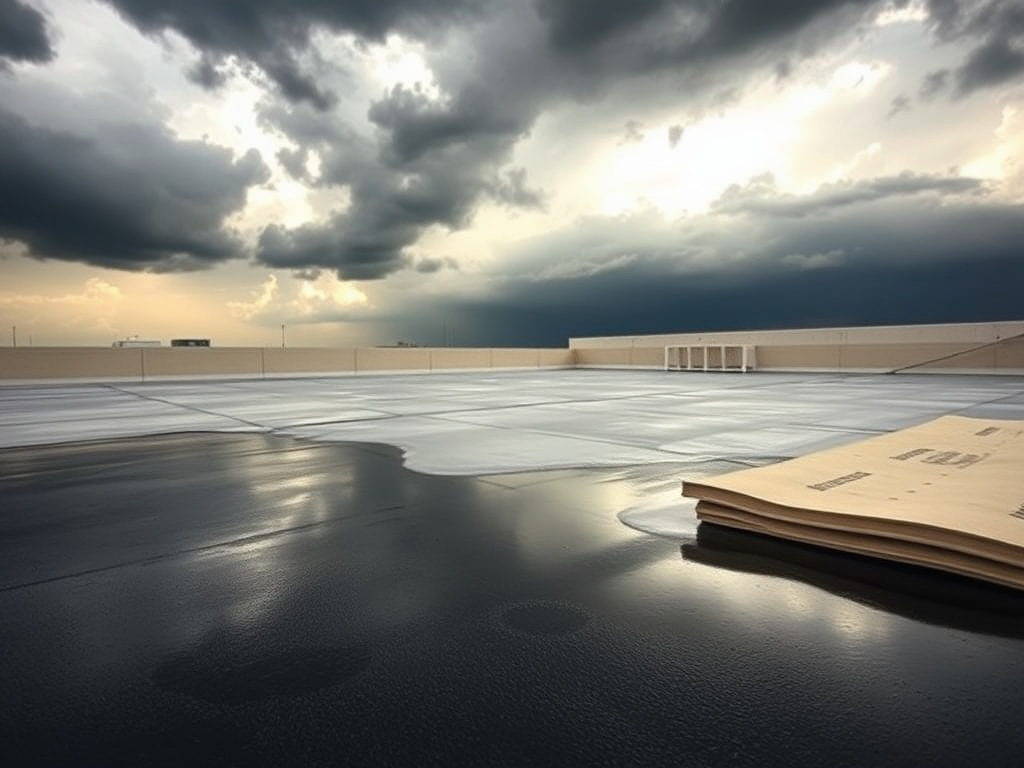
Ponding water roof repair Phoenix
Tapered Insulation & Ponding Water Correction
Some Phoenix flat roofs were never built with real drainage slope to begin with. This page covers the one repair category built specifically for that problem — spray-applied tapered foam that creates a slope-to-drain surface on a roof that has always held water.
A dedicated correction service, not a generic repair
Built for roofs that were dead-flat from day one
A lot of Phoenix's older flat-roof stock has a structural problem no amount of patching will solve: it was built without meaningful slope to a drain in the first place. That shows up two ways across the Valley. Older commercial buildings — strip retail, small industrial, and low-rise office product built decades ago — were often framed dead-flat because slope wasn't specified or wasn't built accurately during original construction. And on the residential side, a large share of Phoenix's 1960s-through-80s ranch homes were built with flat or near-flat roof sections that were never engineered to shed water at all, just to keep the sun off.
On both building types, the result is the same: water that should run to a drain instead sits in a low spot until it evaporates. This page is dedicated specifically to fixing that condition with tapered foam — it is a distinct service from a standard recoat or a spot leak repair, and it's the one correction option that can be built into a roof that was never sloped right without tearing the roof down to deck first.
Why this is a bigger problem here than elsewhere
Ponding water plus Phoenix's UV load is a faster failure path than either one alone
Standing water is a problem for any flat roof, in any climate. Phoenix adds two conditions that make it worse. First, UV exposure here is intense and near-constant — a membrane sitting under standing water for days at a time between monsoon storms takes on moisture stress and heat-driven UV degradation at the same time, at the waterline and below it, rather than one or the other. A dry section of the same roof simply doesn't age the same way.
Second, the Valley's monsoon season brings haboobs — the wind-driven dust storms that are a defining feature of the June 15–September 30 monsoon window. Dust and debris carried by a haboob doesn't just sit on a flat section; it settles into whatever low spots already exist, which are exactly the same low spots where ponding collects. That buildup then clogs the little drainage capacity the roof did have, so the next storm holds water even longer than the last one did. On a roof with a real drainage slope, wind-blown grit washes toward a drain. On a dead-flat roof, it accumulates in the pond itself, and the cycle gets worse with every storm season instead of staying the same.
There's a structural side to this too, and it's often overlooked. Standing water carries real weight — roughly five pounds per square foot for every inch of depth across the affected area. A shallow, spread-out low spot most homeowners would call minor can still be adding hundreds of pounds of sustained load to a section of deck that was never engineered to carry it indefinitely, especially on older residential framing that's already decades into its service life. That load doesn't go away between storms if the water isn't draining — it's a standing condition, not a momentary one, for as long as the pond persists.
How the fix actually works
Spray-applied, variable-depth foam is what makes tapered correction possible
Seamed membrane systems — TPO, EPDM, built-up tar-and-gravel — are manufactured at a fixed thickness and rolled or adhered flat. Building slope into one of those systems after the fact generally means tearing the existing roof off and rebuilding the deck with tapered rigid-board insulation underneath, a full structural project. Spray polyurethane foam is applied wet and cures in place, which means its thickness is controlled entirely by how much material the crew sprays in a given spot. That single difference is what makes in-place slope correction possible.
Low-slope roofing practice generally targets a minimum positive slope of around 1/4 inch of rise per foot of run toward each drain — enough for water to actually move rather than sit. On a tapered correction, that target gets mapped low spot by low spot rather than applied as one blanket number, since a real roof usually has several distinct drainage basins, each needing its own taper plan back to its own drain or scupper.
Map the water
Survey the roof after a rain event or with a hose test to mark every low spot and how deep it holds water.
Plan the slope
Design a slope-to-drain plan from each low spot toward the nearest working drain or scupper, not just a flat build-up.
Build the taper
Spray extra foam depth at the low points and taper it down toward the drain path — thicker where water was sitting, thinner where it wasn't.
True the surface
Blend the tapered sections into the surrounding roof so the finished surface reads as one continuous slope, not a patch.
Topcoat & verify
Apply the protective topcoat, then confirm drainage with a follow-up water test before calling the correction complete.
Diagnosing the problem correctly
True ponding vs. normal after-storm standing water
Not every wet spot after a monsoon downpour needs a tapered correction. Roofing industry practice commonly treats water that drains away within about 48 hours of a rain event as normal storm runoff, not a defect — the roof did its job, it just took a little time. A spot that's still holding water well past that window, or that's visibly wet again days after the last rain with no storm in between, is a genuine ponding condition and a candidate for tapered correction.
That distinction matters because it keeps the scope honest. We inspect and, where useful, track a suspect area across more than one dry stretch before recommending a tapered build-up, rather than proposing correction work on a spot that's simply draining a little slower than the rest of the roof.
| Normal storm runoff | Water present after rain, gone within roughly 48 hours, no recurrence between storms |
|---|---|
| True ponding condition | Water still standing well past 48 hours, or reappearing with no rain event in between |
| Debris-clogged drainage | Slow-draining spot traced to a blocked scupper or drain rather than the roof's slope itself |
| Structural low spot | Consistent standing water traced to a genuine dead-flat or negative-slope section — the case tapered foam addresses |
General guidance — every roof's drainage layout and drain capacity differ; a site walk confirms whether a specific low spot needs correction.
How this fits into a broader project
Stand-alone correction, or built into an install or recoat
Ponding correction doesn't always require a separate project. If a roof already has sound foam and topcoat everywhere except one or two low spots, tapered correction can be scoped as a stand-alone job — we build the slope into the existing membrane at the affected areas and topcoat over it, without touching the rest of the roof. That keeps the cost tied to the size of the actual problem area rather than the whole roof, and it's usually the right call for a roof that's otherwise performing well and simply has one or two spots that were never sloped correctly.
If the roof is coming up on a full recoat cycle, or is a new install or a full replacement, we build the drainage slope into that project from the start, so there's no dead-flat section left to become tomorrow's ponding problem. This is also standard practice on the commercial jobs we run — see our commercial flat roof foam systems page for how tapered slope gets specified into new commercial installs from day one.
If ponding water has already led to an active leak, that's a more urgent scope — see roof leak repair for fast-response service. We work ponding and drainage projects across the Valley; check our service areas or start a quote request with photos of the low spot and we'll scope it from there.
- ✓No tear-off required to correct slope on most roofs
- ✓Scoped as stand-alone or bundled with install/recoat
- ✓Site water-test verification before and after
- ✓Available for commercial and residential flat sections
Get your ponding spot scoped
Send us photos of where water is sitting and how long it stays. We'll tell you honestly whether it needs tapered correction or just a drain clear-out.