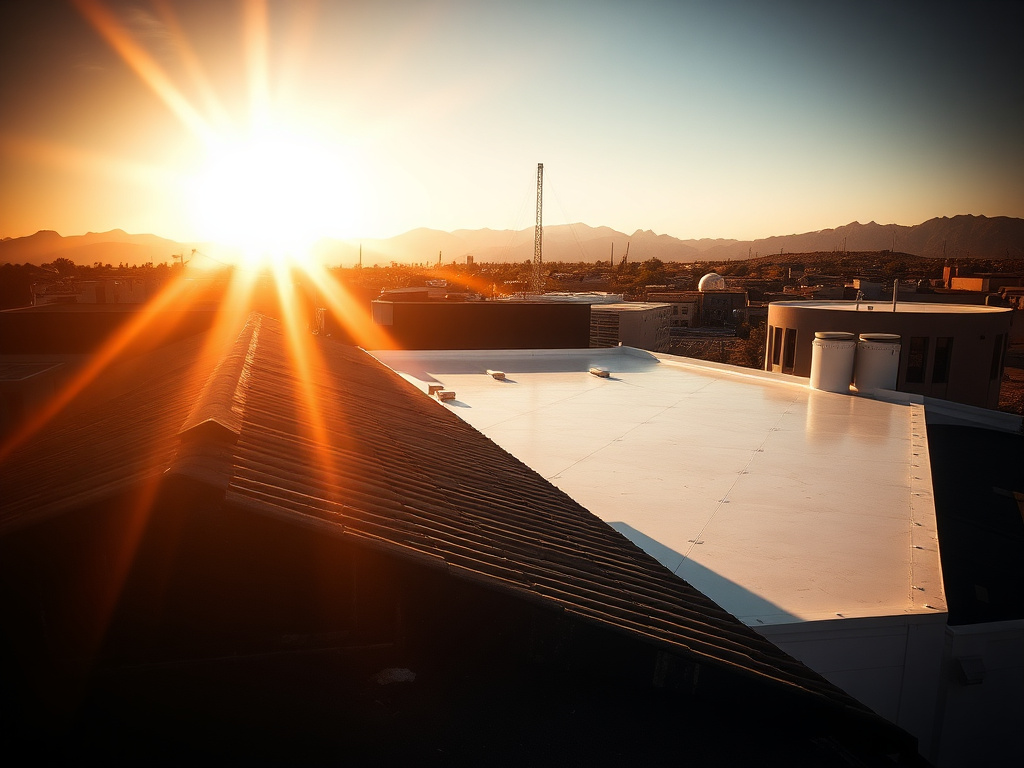
Every Phoenix homeowner and property manager already knows summer here is brutal. What fewer people understand is that the roof over their head is often experiencing a meaningfully worse version of that heat than the air temperature on the evening news — and that the difference between a roofing material that shrugs that off and one that slowly fails under it can run into tens of thousands of dollars over a roof's life. This guide walks through why Phoenix's heat is a distinct engineering problem, what it does to different roof materials, how spray polyurethane foam (SPF) with a reflective topcoat addresses it, what the City of Phoenix cool-roof code actually requires, and how to navigate the SRP and APS rebate programs that can offset the cost of doing it right.
Phoenix's Heat Problem Isn't Just “Arizona Is Hot”
It's tempting to file Phoenix roof heat under generic desert-climate assumptions, but that undersells what's actually happening. Phoenix has a well-documented urban heat island effect, and it's not a minor statistical footnote — it's a measurable temperature gap between the built-up core of the city and the surrounding desert. On a given summer day, official readings at Sky Harbor International Airport, sitting in the middle of miles of asphalt, concrete, and rooftops, commonly run 10 to 14°F above outlying towns like Wickenburg, Queen Creek, or Casa Grande that haven't been paved over to the same degree.
That gap isn't just a daytime phenomenon, either, and the nighttime side of it is arguably more important for a roof. Urban surfaces — asphalt, concrete, and dark roofing among them — absorb solar energy all day and release it slowly after sunset, which is exactly why desert nights that used to cool off dramatically now don't cool off nearly as much inside city limits. Sky Harbor's nighttime minimum temperatures have climbed roughly 9°F over the last half-century, and urbanization — not just broader climate trends — is a major driver of that shift. A roof that used to get an overnight reprieve from the day's heat load increasingly doesn't get one, which means it spends more cumulative hours per year at stress-inducing temperatures than a roof on the same structure would have decades ago, and more than a roof of identical materials sitting out past the urban core today.
For a roofing contractor, that reframes the whole conversation. This isn't “pick a roof that can handle Arizona sun” in the abstract — it's specifying a roofing system for one of the more thermally aggressive urban microclimates in the country, where the building itself is contributing to the very heat load it then has to shed.
What Extreme Roof-Surface Heat Actually Does to Roofing Materials
Ambient air temperature and roof-surface temperature are two very different numbers, and the gap between them is where most roofing failures actually originate. On a 110°F Phoenix afternoon, a dark, low-slope roof surface can climb well past that — commonly into the 150-170°F range for conventional membrane and shingle products — and an unconditioned or poorly insulated attic space underneath can sit around 160°F by mid-July. That's not a one-day spike; it's a repeating daily cycle that runs from roughly May through September, year after year.
How conventional shingles respond
Asphalt shingles are a petroleum-based product, and repeated cycling through that heat range accelerates the loss of the oils that keep the asphalt matrix flexible. Over time that shows up as granule loss, curling, and brittleness — a shingle that might handle 20-25 years of a milder climate can show that same wear meaningfully earlier under Phoenix's heat load, because it's not just absorbing more energy, it's cycling through more freeze-thaw-adjacent expansion and contraction stress per season (even without a hard freeze, the daily swing from a cool pre-dawn low to a 160°F surface temperature and back is its own fatigue mechanism).
How traditional low-slope membranes respond
Built-up roofing and modified bitumen systems rely on seams — laps where one roll of material overlaps the next, sealed with adhesive or heat-welding. Every seam is a potential failure point, and thermal cycling is exactly the kind of repeated expansion-and-contraction stress that works a seam loose over years. Once one seam fails, water intrusion at that single point can travel laterally under the membrane before it ever shows up as a visible interior leak, which is part of why traditional flat roofs so often get discovered leaking somewhere other than where the actual failure point is.
Where SPF has a structural advantage
Spray polyurethane foam is applied as a liquid that expands and cures into a continuous, seamless membrane conforming to the exact shape of the roof deck, penetrations included. There are no laps, no overlapping seams, and no adhesive joints for thermal cycling to work loose over time — the entire roof surface is one monolithic piece. On top of that, foam itself is an insulator: unlike a membrane that just sits on top of the deck, SPF adds real R-value between the hot outer surface and the structure below, which is a meaningfully different proposition than simply covering the roof in a different material.
How SPF Plus a Reflective Topcoat Interrupts the Heat-Load Cycle
Foam alone handles the insulation side of the equation. The reflective topcoat sprayed or rolled over it handles the other side: how much of the sun's energy the roof absorbs in the first place. Two properties matter here, and they're worth explaining in plain terms because you'll see both of them referenced in code language and rebate paperwork.
Solar reflectance is simply how much of the sun's energy bounces off the roof surface instead of being absorbed into it, expressed as a number between 0 (absorbs everything, like flat black) and 1 (reflects everything, like a mirror). A bright white cool-roof coating with high solar reflectance is doing exactly what it sounds like — kicking a large share of incoming solar energy back out before it ever becomes heat inside the membrane.
Thermal emittance is the flip side: of whatever energy the surface does absorb, how efficiently does it radiate that heat back off rather than holding onto it and conducting it downward into the building. A material with high emittance sheds absorbed heat faster, which matters most after the sun goes down, when a low-emittance surface can keep re-radiating stored heat into the structure well past sunset.
Put those two together on a foam roof and you get a system that's absorbing less heat to begin with (reflectance), shedding more of what it does absorb (emittance), and insulating the structure from whatever heat does make it through (the foam's R-value). That's the mechanism — not a marketing pitch, but three distinct physical properties working in the same direction.
The City of Phoenix Cool-Roof Code Requirement (Most Homeowners Have Never Heard of This)
Here's something that surprises a lot of property owners: Phoenix doesn't just encourage cool roofing, it requires it in a defined set of circumstances. City of Phoenix building code sets minimum reflectance and emittance standards for low-slope roofs — generally those under a 2:12 pitch — on new construction and on re-roofing work that affects more than 50% of the roof area. The baseline the code sets is a minimum initial solar reflectance of 0.70 and a minimum thermal emittance of 0.75.
There are exemptions built into the code as well, which is worth knowing before you assume every square foot of a project is subject to the requirement: historic buildings are generally treated differently, areas of roof dedicated to rooftop mechanical equipment (HVAC units, screening) can be exempt, and vegetated or “green roof” sections are handled under separate provisions rather than the standard reflectance/emittance rule. Because code language and its exemptions can be interpreted differently project to project, this is a conversation worth having directly with your contractor and, where it matters, the City — don't assume your specific project's exemption status without confirming it.
The practical upshot for most homeowners and property managers: if you're re-roofing a flat or low-slope section that's more than half your total roof area, you're very likely already required to meet a reflective standard whether or not you were chasing a rebate. A reflective SPF topcoat is one of the most common, straightforward ways contractors satisfy this requirement in the Phoenix market.
SRP Cool Roof Rebate: What the Program Looks Like
Salt River Project runs a cool-roof rebate program for both residential and commercial customers, structured around a per-square-foot incentive tied to installing a qualifying reflective roofing product.
| Residential rebate | $0.30 per square foot, up to $600 per home |
|---|---|
| Commercial retrofit (spray/paint-applied coating) | $0.10 per square foot |
| Commercial retrofit (membrane system) | $0.20 per square foot |
| Product rating requirement | CRRC-rated: 3-year SRI ≥ 86, OR initial solar reflectance ≥ 0.83, OR 3-year reflectance ≥ 0.70 |
| Minimum warranty | 7 years |
Terms shift over time — confirm current rates, caps, and product requirements directly with SRP before budgeting a project around them.
The CRRC (Cool Roof Rating Council) rating requirement is the part homeowners most often overlook — it's not enough for a coating to look white and reflective; SRP wants documented, third-party-tested performance data behind the product, and it needs to clear one of the listed thresholds. This is exactly the kind of paperwork detail a contractor experienced with the program should be handling on your behalf rather than leaving you to track down CRRC listings yourself.
APS Cool Roof Rebate: What the Program Looks Like
Arizona Public Service runs its own cool-roof incentive, structured differently from SRP's and worth understanding on its own terms rather than assuming the two programs mirror each other.
| Rebate rate | $0.75 per square foot |
|---|---|
| Maximum rebate | Up to $50,000 per customer |
| Financing option | Reduced 0.5% APR financing available for qualifying cool-roof projects |
As with SRP, confirm current terms, caps, and eligible products directly with APS before relying on these figures.
The financing piece is worth flagging separately from the straight rebate dollars, because for a larger commercial re-roof or recoat, a sub-1% APR financing option can change the math on timing a project sooner rather than deferring it — but again, loan terms and program availability are the kind of detail that changes, so treat this as a starting point for a direct conversation with APS rather than a locked-in number.
Real-World Payback: Weighing Energy Savings Against Install Cost
The honest answer to “will this pay for itself” is: it depends on your building, and anyone who gives you a single guaranteed number without having looked at your roof, your attic insulation, and your HVAC system is guessing. What we can lay out is the shape of the tradeoff and the variables that move it in your favor or against it.
- ✓Larger roof area relative to conditioned floor space generally means more of your cooling load is roof-driven, which means more potential savings from reflectance.
- ✓An aging or already-degraded roof coating with low current reflectance has more room to improve than a roof that was recoated recently.
- ✓A poorly insulated attic sees more benefit from foam's added R-value than one that's already well insulated, since foam is closing a bigger existing gap.
- ✓Commercial buildings with large, continuously-run HVAC systems tend to see the clearest, most measurable seasonal energy-cost shift.
- ✓Rebate dollars (SRP or APS) reduce the effective installed cost up front, which shortens the timeline to a net-positive payback regardless of your ongoing energy savings rate.
We frame savings in ranges for exactly this reason rather than promising a fixed dollar figure — the physics of reflectance and emittance are well understood, but how that translates into your specific utility bill depends on variables unique to your building. A cool-roof assessment on your actual roof, not a generic estimate, is the only way to get a number worth planning a budget around.
It also helps to separate two different costs that get lumped together when people talk about “the price of a cool roof.” The first is the incremental cost of choosing a CRRC-rated reflective topcoat over a standard one at the time of install or recoat — often a modest difference, since a compliant coating isn't a specialty product in the Phoenix market. The second is the underlying SPF install or recoat cost itself, which you'd be paying regardless of reflectance if your roof needs the work. Rebate dollars apply against the reflective-coating portion of that spend, which is why an accurate, itemized quote — broken out by scope — matters more for cool-roof budgeting than a single lump-sum number would.
Choosing a Contractor Who Can Navigate Both the Code and the Rebate Paperwork
A cool-roof project in Phoenix has three layers that all have to line up: the physical install itself, City of Phoenix code compliance if your project triggers the reflectance/emittance requirement, and the SRP or APS rebate paperwork if you intend to secure it. Any contractor can spray foam and roll on a white coating. Fewer contractors can tell you, accurately, whether your specific re-roof scope triggers the City's code requirement, which CRRC-rated products clear the bar for whichever utility program you're pursuing, and what documentation each utility wants submitted and when.
That's the practical difference between a roof that's reflective and a roof that's reflective, code-compliant, and fully rebated. Ask any contractor bidding a cool-roof job to walk you through, specifically, which CRRC-rated product they're proposing and why it clears the rebate program's threshold — a contractor who can't answer that directly is asking you to take the rebate eligibility on faith.
Before you sign a proposal, it's worth asking a contractor to answer these directly:
- ✓Which CRRC-rated product are you specifying, and what's its documented reflectance and emittance?
- ✓Does my project trigger the City of Phoenix low-slope reflectance/emittance requirement, or does an exemption apply?
- ✓Which utility program — SRP or APS — fits my property, and who's handling the rebate paperwork?
- ✓What's the minimum warranty on the coating, and does it meet the rebate program's warranty requirement?
- ✓What's the expected recoat interval for this specific product under Phoenix sun exposure?
HOA-governed properties and rental portfolios add one more layer worth flagging early rather than after a coating is already on the roof: a reflective topcoat's color and sheen can be subject to the same architectural-guideline review as any other visible exterior finish. Coordinating that approval before install, rather than after, avoids the more expensive scenario of recoating a roof a second time to satisfy an HOA color requirement that could have been checked up front. Property managers overseeing several roofs at once also benefit from staggering cool-roof projects around the monsoon window rather than scheduling everything for the same few weeks, since a reputable crew's install capacity is finite in the run-up to June 15.
Get a Free Cool-Roof Assessment
Get a free cool-roof assessment
We'll walk your roof, check its current reflectance and condition, and tell you plainly whether your project qualifies for City of Phoenix cool-roof code standards and which utility rebate — SRP or APS — fits your building. No obligation.
Frequently Asked Questions
Does Phoenix actually require a cool roof by code, or is that just a rebate marketing term?
+
It's a real code requirement, not just a utility marketing term. City of Phoenix building code sets minimum reflectance and emittance standards for new construction and qualifying re-roofs on low-slope roofs. Reflective SPF topcoats are a common way to meet it, but the code and the rebate programs are two separate things — you can meet code without ever filing for a rebate, and the specific reflectance/emittance thresholds are worth confirming with your contractor and the City for your exact project before assuming compliance.
How much can I actually get back from SRP or APS for a cool roof?
+
Both utilities run their own program with their own rate per square foot, caps, and product/warranty requirements, and those terms move over time. Treat any number you read — including the ones in this guide — as a starting point for a conversation with SRP or APS directly, not a guaranteed rebate amount for your project.
Does a cool-roof coating mean I need spray foam, or can I put it on any roof?
+
Reflective coatings can go over several substrate types, but SPF is a particularly good match because the foam itself adds insulation value (R-value) underneath the reflective topcoat, and a seamless foam surface gives the coating a monolithic membrane to bond to instead of overlapping seams that can telegraph through over time.
How long does a reflective topcoat actually last before it needs to be redone?
+
Reflectance and emittance both drift downward with UV exposure and dust accumulation, which is why recoat cycles exist rather than a 'one and done' coating. Most SPF systems in the Phoenix market are on a recoat cycle measured in years, not decades, though the exact interval depends on coating chemistry, thickness, and how much direct summer sun exposure the roof gets.
Will a cool roof actually lower my summer electric bill, or is that overstated?
+
Reflective roofing reduces the heat load transferring into the building below it, which is a real, physically explainable mechanism — but the dollar amount of savings depends on your building's insulation, HVAC efficiency, roof size relative to conditioned space, and current roof condition. We frame savings as a range based on your specific building rather than a fixed promise.
Does monsoon season affect when I should schedule a cool-roof project?
+
Arizona's monsoon season is an NWS-defined fixed window, June 15 through September 30, rather than a date that shifts year to year based on when storms actually start. Coating and foam application both need dry conditions and roof-surface temperature windows the crew is comfortable spraying in, so most contractors plan cool-roof installs either before that window opens or in its gaps, rather than mid-storm.
Keep Reading
For more on how a cool-roof project fits into a broader SPF roofing decision, see our pages on Cool Roof & Energy Rebates, SPF Roof Installation, and Foam Roof Recoating. If you're ready for a scoped, itemized number on your own roof, start with a free quote.